

For those of you coming here because you saw one of our yard signs, thank you for checking us out! And for anyone who is wondering what is going on over at 3 Suburban Road, this should get you up to speed.
As of now it looks like Wood Partners will be submitting some kind of site plan to the Worcester Planning Board. I haven’t seen the plan yet, I don’t know if one was submitted in time for getting onto the August 26th meeting agenda, but for now I have that date marked on my calendar. It is entirely possible I am wrong and 1,3 Suburban Road plans will be heard at a later date- we’ll know in another week or so. Regardless, at some point this development proposal is going to be heard, and we have to make sure that plans do not get approved without addressing the many layers of issues we have discovered though historical research, reviews of past geotechinical findings, and first hand accounts from residents (some of whom have lived here since the 1930s) and city employees.
I think it’s important for me to restate some of what I wrote in my “Why Peat Meadow is Worth Saving” post in a way that’s more relevant to the upcoming Planning Board meeting, and to qualify the the message on our signs: Save Peat Meadow, Save Worcester. 3 Suburban Road has a complex geology and hydrology, as well as a history of dumping, both city sanctioned and illegal. Building on this site will have wide ranging effects, least of which is increased traffic up and down Highland Street.
One of the easier points to understand is that 3 Suburban Road can hold more water undeveloped than it would developed, and that is especially significant because it sits at the bottom of three hills that drain directly into it every time it rains. Building and paving will cover acres of currently undeveloped land with impervious surfaces, reducing its ability to absorb this runoff. Obviously, water that cannot be held at the property will flow off site to areas of lower elevation, and if that happens beyond the point that the storm sewers can take on the extra water, it will lead to flooding.
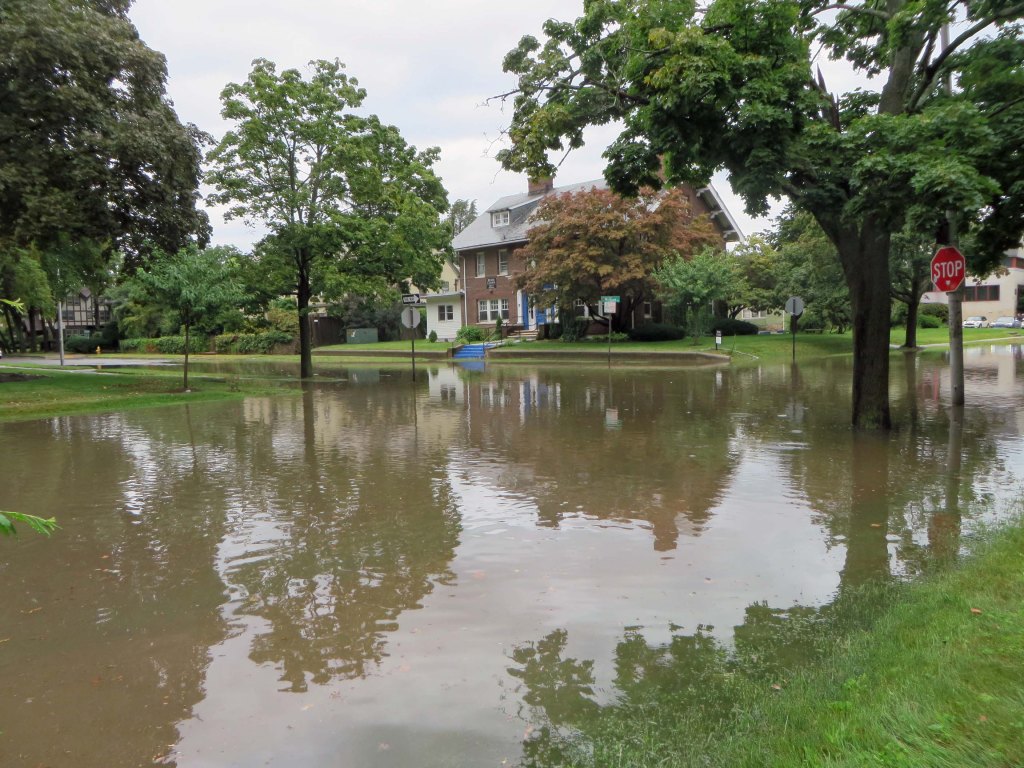
But runoff from the adjacent hills is just the most obvious source of water. Those same hills all contain underground springs that bubble up from deep underground. You see these springs in late winter when the snow begins to melt, after heavy rains, and sometimes running through hillside basements a day or two after a heavy rain storm. Though often travelling underground, this water also heads downhill into Peat Meadow where it is absorbed by peat and mostly kept in place. This is not a small amount of water. It is a constant flow. If the peat is removed and replaced, or simply compressed and covered, it will not be able to hold as much, if any water. Where will that water go?
Speaking of that, water adds volume to peaty soils. Peat is a highly compressible material, and cannot support heavy loads like concrete sidewalks and swimming pools without squishing. Compressed peat holds less water. It also tends to continue to sink downward, along with whatever is on top of it. Or, even worse, leaving what’s on top of it with nothing underneath. Ultimately this could affect houses from Haviland St to Newton Ave as well as the Highland West Apartment building. It would also create additional flooding risks everywhere from the Elm Park area to Newton Square. And, because peat is in a constant state of decomposition, it generates heat. Peat without water will eventually smolder. Underground peat fires can last for years, meaning we have a rare situation where a proposal could increase the risk of both flood and fire.
And then there’s the issue of the fill. Coal ash was used in the early 1900s in an attempt to dry out the land for residential building. That plan didn’t work and, unlike the rest of the Newton Square area that was relatively easier to drain and dry, it remained too wet to build. Already sanctioned as a dumping site, residents began just dropping off whatever they didn’t want to deal with. Economic depression and war didn’t help matters. The land sat and accumulated junk that sits there to this very day, underneath an increasingly wavy and sunken lawn. We don’t know exactly what is under the ground at 3 Suburban, but we’ve seen the ash and the asphalt. One industrious resident used to collect bricks and bottles and sell them at flea markets.
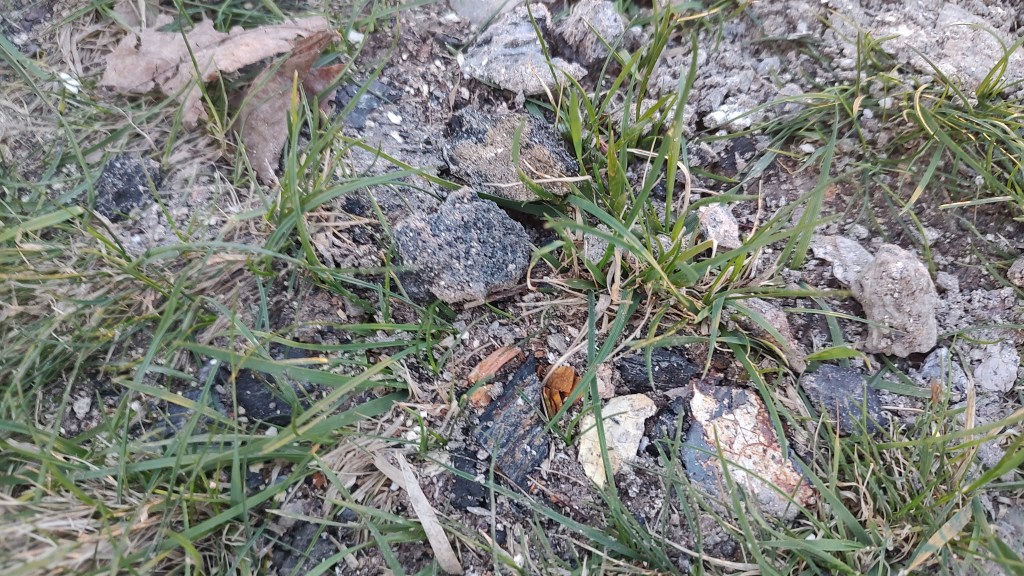
Coal ash, asphalt, bricks, and old glass qualify the land as a “Historic Landfill” exempt from DEP oversight and any required remediation. But coal ash contains heavy metals, and as asphalt decomposes it releases volatile organic compounds (vocs) that are maybe fine left alone, but turn into a concern when driven deeper into groundwater or mixed up into dust that can fly around the neighborhood. Developers use screening and ground wetting to limit “fugitive” dust. But what happens if the trees are all removed and a major rain event begins to wash excavated land into the street? Dry mud turns to dust that winds up on and in everything nearby. There is no way to fully contain contaminated soil, and this site sits across the street from a high school, and within feet of 200 residences.
Coal ash and asphalt are not even all that is here. We’ve seen slag, electronics, an empty metal barrel, toilets- one neighbor describes what he saw in a relatively recent area of excavation on the property as having “everything but a tractor,” and for all we know one of those may be in there too. Until we know what is actually contained in the former “Clark’s Dump,” we have to assume excavation and drilling put the general population at risk.
I know some of you are sure that no one would propose building on this site if it were all this bad. After all, what about the apartment building at 5 Suburban Road (originally Highland House), built on the same land in 1963?
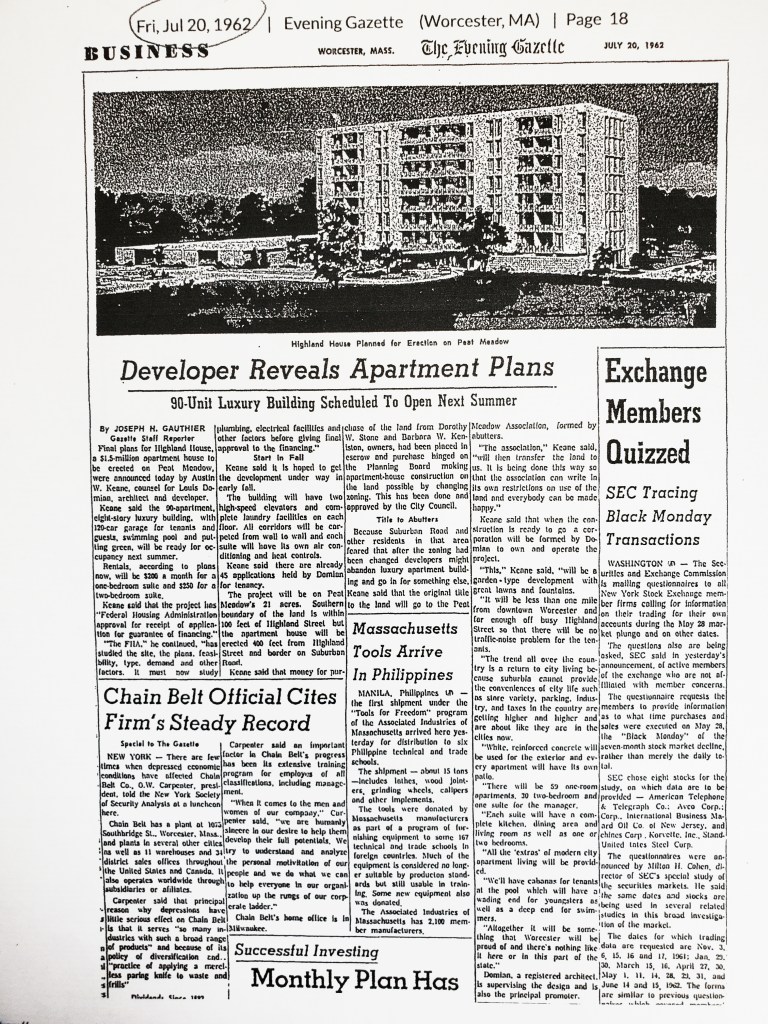
Highland House may have been originally built quite well, but it experiences frost quakes every winter indicating there is quite a bit of water under the building. Its location was originally selected out of all the possible locations of 3 and 5 Suburban Road combined, and it sits on one of the shallower parts of the deepest part of the bog. It is fine all alone out there, but it was designed to be all alone out there- the building was originally deed restricted so that nothing else would be built on the remaining land. Was it built well enough to withstand the kind of construction that will be proposed within 20 feet of its walls? What if, during new construction, water winds up redirected under the building? What if the ground under it begins to subside at a higher rate than it currently experiences? Highland House is the reason building here becomes absurdly complicated, because everything that can be done to make the new buildings safer, puts Highland House at increased risk.
This is a complex situation that, at the very least, needs very careful review before anything moves forward. Current policy related to development is designed to make everything easier and quicker, but in this case an environmental study cannot be completed in thirty days. We need to know 3 Suburban Road’s role in the hydrology of the whole region, we need to know how much water is actually held here in the wet season of a non-drought year, we need to know if building so close to the existing apartment building is safe, and we need to know what would be done to protect directly abutting home owners on Highland and Haviland street from subsidence and soil pressure changes. On top of that (quite literally), we need to understand the fill, the risk to current and future residents, and the risks of excavation vs leaving it alone. And we need all this information from an impartial third party and all test procedures and findings made public in real time.
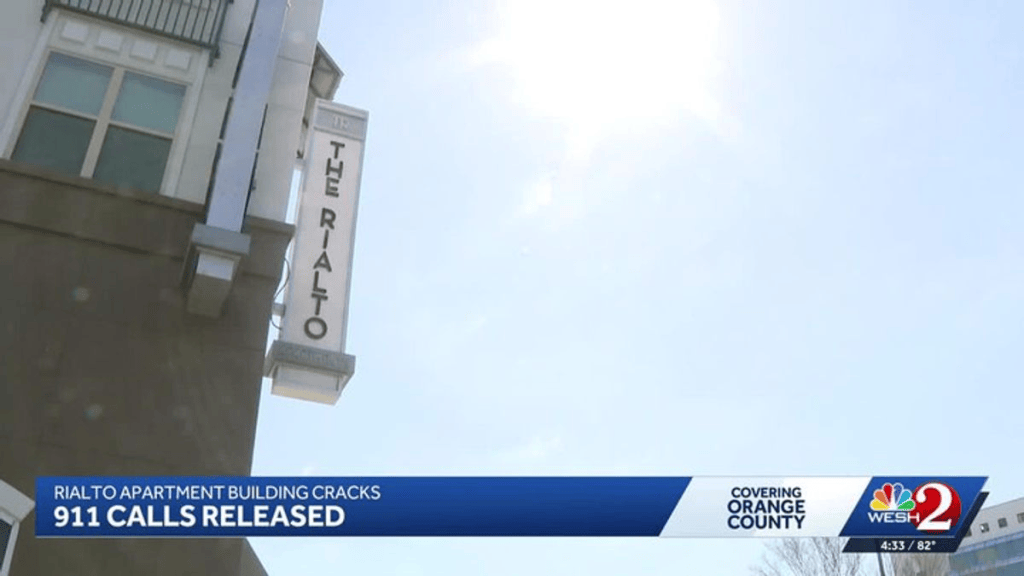
There has been a lot of construction failure in the news over the last few months. Hundreds of people have been displaced overnight, roads have been closed, areas have been evacuated, expensive fixes have made things worse. Bad planning, the choice to ignore geotechnical realities, and failure of oversight have put huge numbers of people at risk, wasted millions of dollars, and left the future viability of multiple properties in serious question. We don’t want to see one of these stories here. Let’s make sure all these issues are addressed before a problem too big to easily solve burdens the whole city. Let’s save Peat Meadow. Let’s save Worcester.


Leave a comment